

Nov 10 – St Leo the Great, (1) pope and doctor of the Church (400-461)
Summary: Pope Leo the Great was a layman when chosen for the office; he was able to keep the invaders from the north – the Huns and the Vandals – at bay; he was a focus for unity in the Church; and he gave powerful expression to the dignity of all Christians who believe in the incarnation of Jesus, truly God and truly human.
Leadership
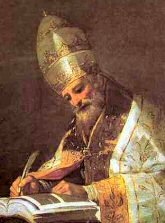
Leo is rightly called ‘Great‘ for all manner of things that he did and for the way he led the Church at a time of political turmoil. However I want to remember him this month – as we approach the holy season of Christmas – mainly for something he wrote, but more about that later.
Worthy Lay Papal Candidate !
Leo was born in Tuscany, central Italy, about the year 400 but the family came to live in Rome when he was still young. Strangely enough, Leo was not even a priest or a bishop when he was chosen to lead the Church of Rome.
His position was more that of a civil servant and he was away on a civil mission in France to bring about peace between two of Rome’s military leaders when the call to return came. The clergy and the people of the city could think of no more worthy candidate for the vacant see after the death of Pope Sixtus III. By the clarity of his vision for the Church and by the force of his administration he was to do much to fashion the papacy as we know it.
Northern Invaders
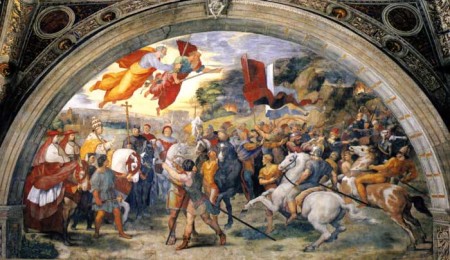
It is said that were it not for the Popes, Rome today would very likely be a mass of ruins like Babylon or Carthage or other ancient cities. Leo is especially remembered for saving the city from the invasions of the Northern tribes. The power of the empire was at a low ebb at that time and the prospect of riches and fame was attractive to the invaders from northern Europe. Attila the Hun came in 452.
‘Doctor’ of Unity
Leo also combatted heresy in any form whatever. Whether it was the Manichaeans in Italy or the writings of the British monk Pelagius, Leo was a fiery opponent and an able adversary. ‘The integral and true faith is a great bulwark to which nothing can be added or taken from by anyone.’ In his encyclical Aeterna Dei Sapientia (1961), Pope John XXIII wrote, ‘St. Leo is celebrated above all as the Doctor of the unity of the Church.’
Leo constantly appealed to the canons of the Council of Nicea (325) and often in his sermons cited previous decisions of the popes. Above all, he had a clear sense of his own role in speaking for the whole Church. ‘For the stability which the Rock himself was given by the Rock which is Christ, he conveyed also to his successors, and wheresoever any steadfastness is apparent, there without doubt is to be seen the strength of the shepherd.’
This love for the Church even extended on occasion to the correction of his fellow bishops. One such was St. Hilary, bishop of Arles. Hilary, a holy and saintly man, had deposed Celidonius, bishop of Besancon. The latter had come to Rome to appeal and Hilary quickly followed to make his case. At the same time, others had protested that Hilary had consecrated another bishop while the incumbent was sick but still in office.
In a letter to the bishops of Gaul (France) Leo declared Hilary deposed from metropolitan jurisdiction and limited to his own bishopric: ‘Anyone who dares to secede from Peter’s solid rock may understand that he has no part or lot in the divine mystery.’ Hilary, saint that he was, submitted and peace was restored to the church of that region.
Christology
Many of Leo’s sermons have come down to us today. Written in Latin they are renowned for their clarity of thought and ability to reach the common man. However it is his Christmas sermons (eight in all) which above all merit his unique role in Christology.
When Christians gaze upon the crib today or attend Midnight Mass, they inherit the truths which Leo crafted in his sermons and writings. In the divine office for the feast his words echo through the centuries: ‘Christian, be aware of your dignity for it is God’s own nature that you share.’
In one of Leo’s 173 letters, dubbed ‘The Tome’, he wrote to St. Flavian, bishop of Constantinople, in reference to the views of an abbot, Eutyches, which had been condemned earlier at a synod held in the great Eastern city. ‘The Tome’ is dated 13 June 449 and later it was read to more than 500 bishops at the great Council of Chalcedon in 452.
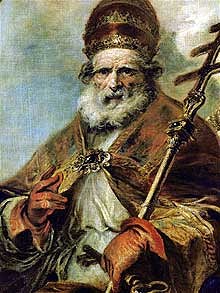
St. Leo’s words describe the greatest moment in human history, that moment when God the Son took on our human nature:
‘Thus the Son of God enters this lowly world, He comes down from the throne of heaven, yet does not separate himself from the Father’s glory. He is born in a new condition, by a new birth. Beyond our grasp, He chose to come within our grasp.
‘Existing before time began, He began to exist at a moment in time. Lord of the Universe, He hid his infinite glory and took the nature of a servant. Incapable of suffering as God, He did not refuse to be a man, capable of suffering. He who is true God is also true man.
With Magi and shepherds, with Mary and Joseph, we can but only adore.’
_________________________
******************************
Memorable Saying for Today
St Peter committed one of the greatest sins, denying Christ,
and yet they made him Pope. Think about that today.
~ Pope Francis ~
******************************
Summary : St Leo the Great, pope, Doctor of the Church, Elected pope in 440, he died in Rome on this day in 461. . Tried to protect the city from the devastation of barbarian invasion. His surviving letters illustrate the leadership and guidance he exercised as bishop of Rome toward other Churches in the West. Noted for the clarity of his thought on the two natures of Christ, he was affirmed at the Council of Chalcedon, for his eloquent sermons, and for the prayers he composed for the Roman liturgy, he was made a Doctor of the Church.

Pope Leo heightened the profile of the papacy as the power of the Roman empire declined. After persuading Attila the Hun at Mantua not to proceed further down into Italy, Leo was accepted as exercising universal authority in the church, not only over all the faithful, but over all the bishops in the world as well.
Patrick Duffy outlines his achievements.
Elected pope in his absence
Leo was a native of Tuscany and became prominent as a deacon of the Roman Church under Pope Celestine I (422-32). During the pontificate of Sixtus III (432-440) he was sent to Gaul in the summer of 440 to act as a mediator in a difficult situation between a provincial governor and the commander-in-chief in Gaul. While he was in Gaul, Pope Sixtus III died, and Leo was elected in his absence to succeed him. When he returned to Rome, he was consecrated on 29 September 440. His pontificate lasted more than 21 years and was one of the most important in the Church’s history.
Political leader in Difficult Times
During the invasions from the northern tribes (Huns, Vandals and Goths), the imperial authority in the West had weakened. This long, drawn-out social crisis forced this pope – as it did Gregory the Great a century and a half later – to play an important role in civil and political events.
Against Attila
In 452 Pope Leo went with a Roman delegation, to meet Attila, chief of the Huns, in Mantua and succeeded in dissuading him from his war of invasion in which he had already devastated the northeastern regions of Italy. This important event is emblematic of Leo’s action for peace.
Against Genseric
A second papal initiative three years later was not quite as successful, but it showed his outstanding courage: in the spring of 455 Leo did not manage to prevent Genseric’s Vandals, who had reached the gates of Rome, from invading the undefended city which they plundered for two weeks. But his gesture of going out to meet Genseric, defenceless and surrounded by his clergy, prevented Rome from being burned. It assured that the Basilicas of St Peter, St Paul and St John, in which the terrified population sought refuge, were spared.
Sermons and Letters
Leo’s 100 sermons – in a splendid and clear Latin – and his 150 letters show his exercise of the Word and his devotion to the service of truth in charity. He presented himself as the Apostle Peter’s authentic heir and as a tireless champion and upholder of the Roman primacy.

The most important letter of Leo was that sent to the Patriarch of the East Flavian, which when read to the bishops assembled at the Council of Chalcedon (451) was gratefully acclaimed. “It is Peter who has spoken through Leo. This is what we all of us believe. This is the faith of the Apostles”, the 500 Council Fathers cried out in unison. It rejected the heresy of Eutyches who denied the true human nature of the Son of God, affirmed the union of both the divine and human natures in the one person of Jesus, without confusion or separation. This quotation expresses the true doctrine:
“The proper character of both natures was maintained and came together in a single person. Lowliness was taken up by majesty, weakness by strength, mortality by eternity. To pay off the debt of our state, invulnerable nature was united to a nature that could suffer; so that in a way that corresponded to the remedies we needed, one and the same mediator between God and humanity, the man Christ Jesus, could both on the one hand die and on the other be incapable of death.
Thus was true God born in the undiminished and perfect nature of a true man, complete in what is his and complete in what is ours. By “ours” we mean what the Creator established in us from the beginning and what he took upon himself to restore. There was in the Saviour no trace of the things which the Deceiver brought upon us, and to which deceived humanity gave admittance. His subjection to human weaknesses in common with us did not mean that he shared our sins. He took on the form of a servant without the defilement of sin, thereby enhancing the human and not diminishing the divine. For that self-emptying whereby the Invisible rendered himself visible, and the Creator and Lord of all things chose to join the ranks of mortals, spelled no failure of power: it was an act of merciful favour.
So the one who retained the form of God when he made humanity, was made man in the form of a servant. Each nature kept its proper character without loss; and just as the form of God does not take away the form of a servant, so the form of a servant does not detract from the form of God.”
Pastoral Action
Leo knew how to make himself close to the people with his pastoral action and his preaching at a time when Rome was tried by famines, an influx of refugees, injustice and poverty. He opposed pagan superstitions and the actions of Manichaean groups. He associated the liturgy with the daily life of Christians: for example, by combining the practice of fasting with charity and almsgiving especially during the Rogation or Ember Days, which marked the change of seasons.
Sense of Liturgy
In particular, Leo taught – and his words still apply today – that the Christian liturgy is not the memory of past events, but the actualisation of invisible realities which act in the lives of each one of us. This is what he stressed in a sermon (cf. 64, 1-2) on Easter, to be celebrated in every season of the year “not so much as something of the past as rather an event of the present”.
Death
Pope Leo died on 10th November 461 and was buried near the tomb of St Peter. Today, his relics are preserved in one of the altars in the Lateran Basilica.
_______________________
******************************
Memorable Saying for Today
Let us invite Jesus into the boat of our lives.
Let us hand over our fears to him…because this is God’s strength:
turning to the good everything that happens to us
even in the bad things.
~ Pope Francis ~
******************************